
DIABETIC FOOT EXAM
| Inspection of Feet and Shoes | Look for Charcot Foot (big subluxation of the tarsal bone, joint moved slightly out of position) Look for wearing of the shoe sole, especially medially. |
| Inspection of Gait | Have the patient walk in a straight line, turn and walk back to you. Look for symmetry/balance as well as antalgic gait to avoid pain while walking and assess how they turn (speed, rhyth, balance) |
| Touch | Ask the patient to remove the shoe and sock on one side. Ask the patient to close eyes and tell you when they feel something. Press monofilament near the patient’s sternal notch and tell them this is the sensation they should expect to feel. With the patient’s eyes still closed, press the monofilament on the following 10 locations. Report a negative test for each location that is sensed. 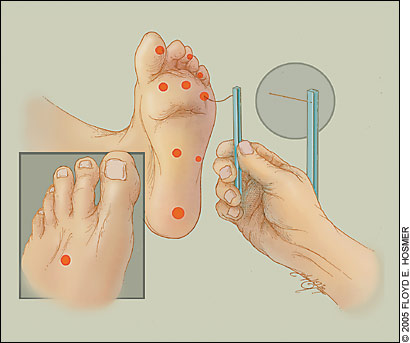 |
| Vibration | Ask patient to close their eyes and tell you when they start and stop feeling the vibration. Test the vibrating tuning fork on your own sternum to ensure it works. Strike 128 hz tuning fork hard against table surface and test on patient’s sternum. Test the dorsum of the first toe on feet, medial maleolus, metatarsal joint and head of the first metatarsal bone. Report grade: 1 point if vibration perceived, second point if vibration dampening perceived. |
| Proprioception | While stabilizing the joint you are adjusting, grab toe from the sides and ask patient to close eyes. Randomly move the toe up or down and ask patient to report which direction it is moved. |
| Ankle Jerk Reflex | Ask the patient to relax their leg, while hanging leg off of exam table. Use reflex hammer to tap the achilles tendon. Report grade: 0 = absent reflex 1 = hypoactive reflex 2 = normal reflex 3 = hyperactive without clonus 4 = hyperactive with clonus |
 Stethopedia